
The sale of peat compost to the retail trade i.e. the general public is likely to be banned soon. Campaigners are trying to get this ban enforced at the end of this year (2025). Commercial sales have a bit longer and possibly until 2030 but as you can imagine, we get asked the above question a lot. Therefore, we thought we would try and answer.
The quick answer is…. IT DOESN’T REALLY MATTER but let me explain…. Grab yourself a cuppa, sit back and enjoy.
All views expressed are our own from our own experience. We are not scientists or experts, but we wanted to give you our level of experience so when you find you can’t buy that bag of Peat, it isn’t so scary.
Why the ban on peat? We don’t want to go into this at all. There are thousands of articles, views and analysis out there. The government themselves have written this https://www.gov.uk/government/news/sale-of-horticultural-peat-to-be-banned-in-move-to-protect-englands-precious-peatlands
The simple fact is that we won’t be able to use it soon. We don’t want to add to the controversy either. We made the decision to grow Peat Free many years ago (and peat reduced before then), so we feel we are in a position to help you all.
The difficulty surrounding peat free is that it costs growers a fortune to trial different types. Each delivery is usually a minimum of 4 or 6 pallets. Compost is mixed using specialist machinery that must be ‘programmed’ specifically for a recipe. If we want a bespoke recipe, the manufacturer has to set a minimum order quantity – fair enough!
If that compost isn’t perfect or it requires more work than another to keep plants as beautiful as they should be, it costs time and money. We estimate an extra expense (or loss!) of approx. £100,000 over the last 8 to 10 years!
This is where we have our first point. You can’t use the same peat free compost for everything! This would seem obvious to most but in a world of ‘multipurpose’ we need to re-think our strategies.
For many years going back to 1986 we used a low nutrient, bespoke mix based on a John Innes formula of Kettering loam, peat and grit. This was perfect and produced firm growth to provide plenty of scent and flavour. We never, ever, had to add extra feed because a combination of peat and loam locks in the nutrient and releases it to a plant’s own requirements. Too much feed makes for a rather a lax plant lacking in flavour and scent. So for us, changing to peat free which, on its own, cannot lock in nutrient, would have seemed much easier. (Ha!) Herbs, as a rule, like a poor, free draining soil but Pelargoniums are different, Mints are different and so too are Salvias or Parsley or Wormwood etc. We could honestly have 4-5 different composts…..so we do!
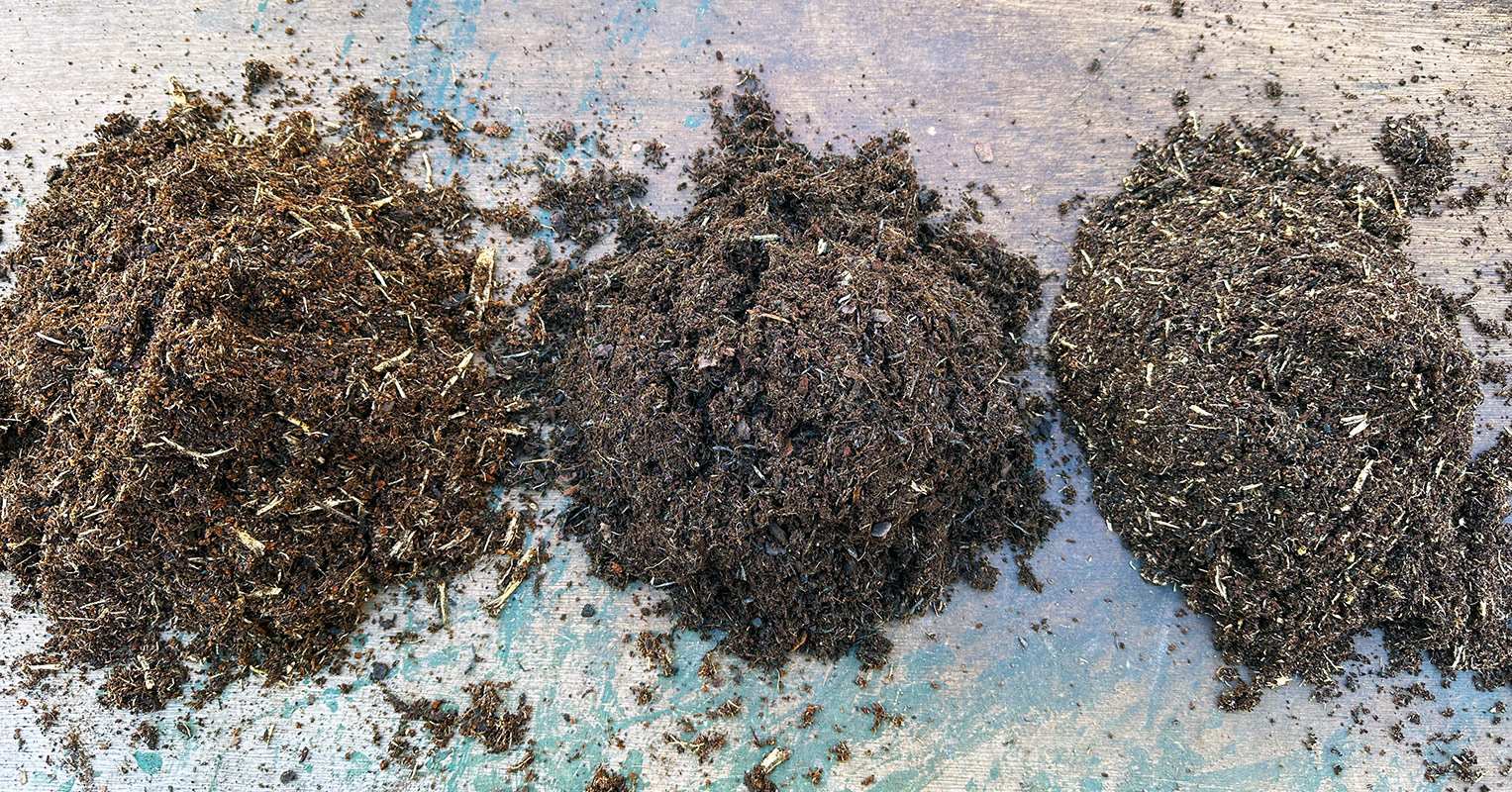
The base ingredients are similar though. Wood bark, wood fibre and coir are the main 3 and you can see 3 different ‘off the shelf’ bags from 3 different manufacturers below.

Even though the ingredients are similar, the ratios differ, and the how fine the materials are too. We won’t talk about coir in this article. The use of coir is being carefully considered amongst the major manufacturers, and some have already started reducing it BUT please note that growers are doing what the can to reduce or stop using peat so to find a coir substitute too is not easy (not impossible) but not easy.
We have base composts, usually two or three and from different manufacturers. Some of our range will work fine ‘out of the bag’ (Remembering that this bag will contain a bespoke mix). For the other 40% of our range, we need to tweak this compost. We may need to add more feed to it, we may need to add loam (soil). We could add grit or perlite.
You can see the ‘additives’ we can add below

Loam is essentially soil. It is a mix of sand, silt and clay and depending on batch, can also contain a little organic material too. Perlite is volcanic glass expanded a bit like pop corn. This aids drainage but also holds moisture too. Slow release fertiliser is a complex granule of the base NPK elements surrounded by a coating that breaks down over time to release these nutrients to the plant. Different coatings and ratios of NPK mean we can have different releasing fertiliser. Some release faster over a shorter period of time and others slower over a longer period of time.
My second point. If you can’t use the same compost for everything then make your own.
Use a bag, any bag. As I said earlier it doesn’t really matter. Some hold more water, some will have more feed, some will be dyed to look like peat, some will be free and dusty to look at. Just use one that you can obtain easily and then think what you are going to grow. Just don’t buy cheap. Spend what you can in hope to get the best.
Add some of your own well-rotted garden compost, or add leaf mould or some loam. Add some perlite, add water retention granules, add slow release feed. Think about your plant’s needs and go from there. You are in a lucky position to be able to create your own bespoke mix for each plant you grow. Just keep playing with a recipe. You can even make your own that will work for many plants from scratch using waste material. See Monty Don’s explanation here https://www.youtube.com/watch?v=r4YThQXM_54
We are primarily a herb grower so this next bit will be for our customers.
All plants purchased from us will be in a compost with added nutrient. First, we have a base feed. This is a small amount of relatively fast releasing feed to help the plant in the first 6-8 weeks of its potted life. We then add slow release feed to give that plant a slow release of feed over a course of 3-5 months or longer. This is necessary because, as previously mentioned, peat free compost cannot lock in any nutrient. Now, herbs don’t like much feed! Well, this is true but they do need something and others will want more. A lavender won’t but a parsley will. We don’t change this base feed but we do change the slow release. Usually for a herb that doesn’t require as much, we add a product that releases a smaller amount but over a longer period of time. Complicated isn’t it! Actually, not really, as we have done this for you!
So what about watering….
The RHS have run trials with some larger growers and the results seem to be that Peat free can have better water holding capabilities https://www.hortweek.com/rhs-trials-show-peat-free-compares-peat-using-amount-water/ornamentals/article/1897961
We were not involved in this trial and we don’t know all the results but in our opinion this is can be true but it does depend on many factors. If growing one crop in one tunnel then watering is easy. You can select at random a few plants, check to see how the water is soaking through and adjust the watering. However, when we have 100 or more different varieties in one tunnel, this makes it very tricky and it will be the same for you in your own greenhouses, roof gardens and terraces. Once you have got used to the compost and the water demand it is straight forward but we have started yet another peat free trial ourselves and we mentioned this on social media late last year. Water retention is the topic and we are excited to post results later this spring. https://www.instagram.com/norfolkherbs/?hl=en
I wanted to show this photo. It is of a Roman Chamomile in a 2 L Pot. A great root system but even though this was on overhead irrigation for 4 minutes, the water has only penetrated the top inch of the profile. We therefore must walk the tunnels and water larger or more demanding plants again.

Many of the components of peat free compost are dry ingredients (wood fibre, coir etc). Some manufacturers send compost damp, some strip moisture out to make bags lighter for people to move and make distribution cheaper as well. This dry compost is not too dissimilar to the nicer looking peaty products you may have seen just with a lower initial moisture content. It oftens needs watering before use.
You can see the differences looking at the photo earlier.
If the plant you buy isn’t destined for the open ground then please read this next paragraph
Container growing does need further thinking. We assume that the plant will be in this container over the winter. Much of the R and D into peat free compost goes into water retention. However, what happens over the winter? This already damp compost will not dry out much, particularly a few inches below the surface. What is below the surface? Root of course and these can rot. So, for all our work trying to keep these plants damp over the summer we must turn our attention to stop them getting waterlogged over the winter. In all our experience, peat does this better BUT, we can easily rectify it by adding more drainage material to our pots. We have all seen Monty do it on Gardener’s World and we must do the same. Drainage, drainage , drainage! It is very true!
Also, we need to discuss the weather. Peat in itself is an inert material with no real nutrient benefit but it has this natural ability to hold onto given nutrient and buffer it. Couple with a decent loam, a peat based compost is far superior for releasing nutrient to a plant. There is not much getting away from this.
Peat free does require more feed (in our opinion). Whether we add organic or inorganic feed, it is virtually impossible to completely control the speed at which the nutrient is released. On hot days, a slow release fertiliser bead will break down faster. Over a wet summer, nutrient can leach out from a pot.
Our third main point therefore is to prepare to liquid feed (organic if you can)
Finally, remember that the compost you buy does have a short shelf life. Keep an eye on manufacturing dates, see where the supplier has stored it. Kept in the sun, it can heat up, nutrient can break down and leach into the compost and when used can burn young roots. We recommend that a bag with slow release feed needs to be used within 3 months and stored cool and away from direct sunlight.
Growing in peat free is great, as long as we follow a set of rules but we must go back to basics almost. Rethink how we grow and to be fair, if you have purchased one of our plants in the last 8 years, I am sure you have been happy with the quality. We do believe that some of our plants are even better grown in Peat Free.

So, there is no real answer to this commonly asked question, just think about you want to grow, add a few things to a bag, watch the weather and you will be fine!
On a final note, I did mention at the start that the ban of commercial sales of peat compost to growers won’t be enforced at the same time as retail sales. This is because growers need to find their perfect mix. We are lucky that we are a small grower and are already peat free. Change, even if it is for good reasons costs money and we all need to stay in business. It is sad that our generation of growers have been the ‘guinea pigs’ and have had no Government grants to aid the huge changes and trials. Many specialist growers including Hosta growers or those growing Predator plants are finding the transition more difficult so PLEASE PLEASE PLEASE, still support the few nurseries that still have to use Peat – it isn’t always easy! Horticultural Peat use in the world is so small anyway and it is equally important to preserve those nurseries, gardens and green spaces which are there to soak up the carbon too.